.png)
The Digital Front Door: What It Is & Why It Matters
Making a strong first impression has always been essential for healthcare practices, but now, your patients get to know your practice before even stepping foot in your waiting room. Many patients now look to online, self-service options to book their care, and your practice must be prepared to meet them where they are. In fact, recent studies show that:
- 89% of patients want self-service scheduling
- 85% dislike manually filling out repetitive intake paperwork
- 96% want a cost estimate before their treatment
That’s why it’s so important for practices like yours to invest in their digital front door. This holistic approach to practice management ensures every introductory patient touchpoint, from the initial Google Search to their appointment slot, is part of one seamless and convenient online journey.
Moreover, modern practices need to consider their digital front door when future-proofing their operations. The U.S. digital front door software market is expected to triple in size by 2030, so adopting this strategy is crucial to keep up with the competition and evolving patient expectations.
Let’s explore what a digital front door is for healthcare organizations and how to ensure your practice leverages this framework to its full potential.
Table of Contents
- Digital front door FAQs
- Components of an effective digital front door strategy
- Legacy vs. modern healthcare management workflows
- How to implement a digital front door strategy
- What platform provides the best front door ecosystem?
Digital front door FAQs
What is a digital front door?
The digital front door is a strategy of consolidating disparate software solutions used to manage healthcare practices into one technology ecosystem. Some technologies that fall under the digital front door umbrella include tools for:
- Online appointment scheduling
- Telehealth
- Digital intake/check-in
- 24/7 automated assistance
- Real-time insurance verification
- Practice website management
- Patient communication (SMS, email, and phone)
However, remember that a digital front door is not just a patient portal. While a patient portal is a static silo of information, the digital front door presents an omnichannel approach that unifies every aspect of the patient’s experience. In other words, a patient portal is just one part of a practice’s holistic digital front door strategy.
Why is having a digital front door important?
Opting for a more comprehensive solution like the digital front door is worth the work and investment. It presents benefits such as:

- Meeting patient demand: Convenient, unified digital processes give patients greater control over their own health journey, increasing the likelihood that they’ll come back.
- Staff retention: Handling endless floods of messages and reconciling information between disparate systems wears on your team over time. The healthcare industry already struggles with turnover, so a digital front door strategy can provide much-needed relief.
- Revenue protection: More and more practices are investing in their digital front doors. Keeping pace with the industry is crucial to fuel the business side of your practice.
- Improved reputation: A seamless, modern patient experience increases trust and satisfaction, leading to positive online reviews and word-of-mouth referrals.
Who benefits from a digital front door approach?
Patients and staff alike benefit from having a digital front door! While patients receive the care and information they need quickly, your team can knock out your most time-consuming tasks and fill appointment slots.
If you’re a small practice concerned about your budget, don’t be. There are many software solutions on the market built for the needs and resources of smaller practices.
How long does it take to implement a digital front door strategy?
The timeline for implementing a digital front door strategy varies greatly, generally ranging from a few months to over a year, depending on the complexity of the practice’s needs and the scope of the project. Key factors influencing implementation time include:
- The current state of existing digital infrastructure
- The number of systems that need integration (such as EHRs, scheduling, and patient portals)
- The level of customization required
- The internal resources dedicated to the project
You’ll need to create a detailed list of your goals for implementation before you seek out technical support or new systems.
Components of an effective digital front door strategy
Though every digital front door strategy will look different, including these elements is best practice and provides a foundation for you to build on.
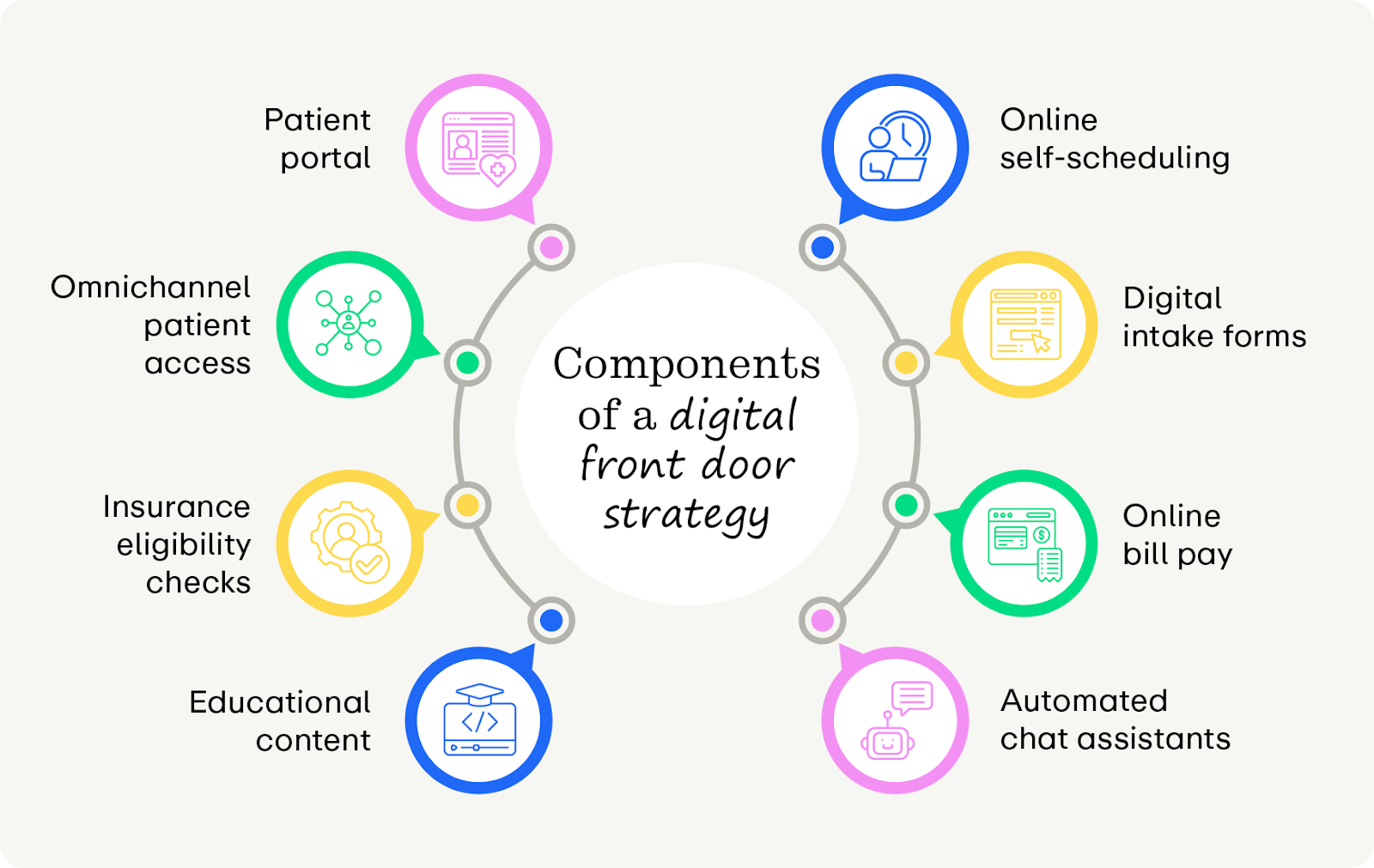
- Patient portals. Online portals are critical for sharing patient information, checking appointment status, and communicating with care providers. Though the traditional portal log-in format is now outdated (more on that later), having a patient-facing central hub makes the clinical process more approachable.
- Online self-scheduling. With appointment wait times surging to an average of 31 days, your practice will stand out if patients can schedule appointments as quickly as possible. Your scheduling tool should update automatically when slots fill, avoiding costly double-bookings.
- Omnichannel patient access. Being online isn’t enough to keep patients engaged anymore. Your practice should leverage multiple communication channels, like SMS and email. Also, your patient engagement portal should be mobile-accessible to give patients on-the-go access.
- Digital intake forms and check-in. Clunky clipboards and paper forms don’t have to be bottlenecks in your workflow anymore. Using digital intake forms and check-in tools ensure patients get seen as soon as possible.
- Insurance eligibility and price transparency. No patient wants an unexpected bill for a service they believed was covered by their insurance. You need systems that verify coverage and eligibility in real time so your patients know exactly what to expect.
- Online bill pay. It’s no wonder that 85% of consumers prefer paying medical bills online. It’s a win-win—your patients can pay their bills hassle-free, and your practice typically gets paid faster!
- Educational content. Providing educational material to patients helps them feel more comfortable about their procedures and increases compliance with pre- and post-procedure instructions. Ensure these materials are digitized and easily accessible via your patient engagement platform.
- Automated chat assistants. In the healthcare world, patients have pressing questions that require prompt answers, even when your staff is busy or it’s after business hours. Instead of using precious staff resources to constantly man the phone, add AI-powered intelligent chatbots that can help patients 24/7 with basic tasks (think confirming appointments, not giving medical advice).
These are just a few of the tools that might comprise your practice’s digital front door ecosystem. This list might change based on your practice’s specialty and size.
Legacy vs. modern healthcare management workflows
To demonstrate just how important having a digital front door is, check out this side-by-side of legacy and modern healthcare workflows:
How to implement a digital front door strategy
Ready to deliver the modern experience your patients deserve? Get started with these tips:
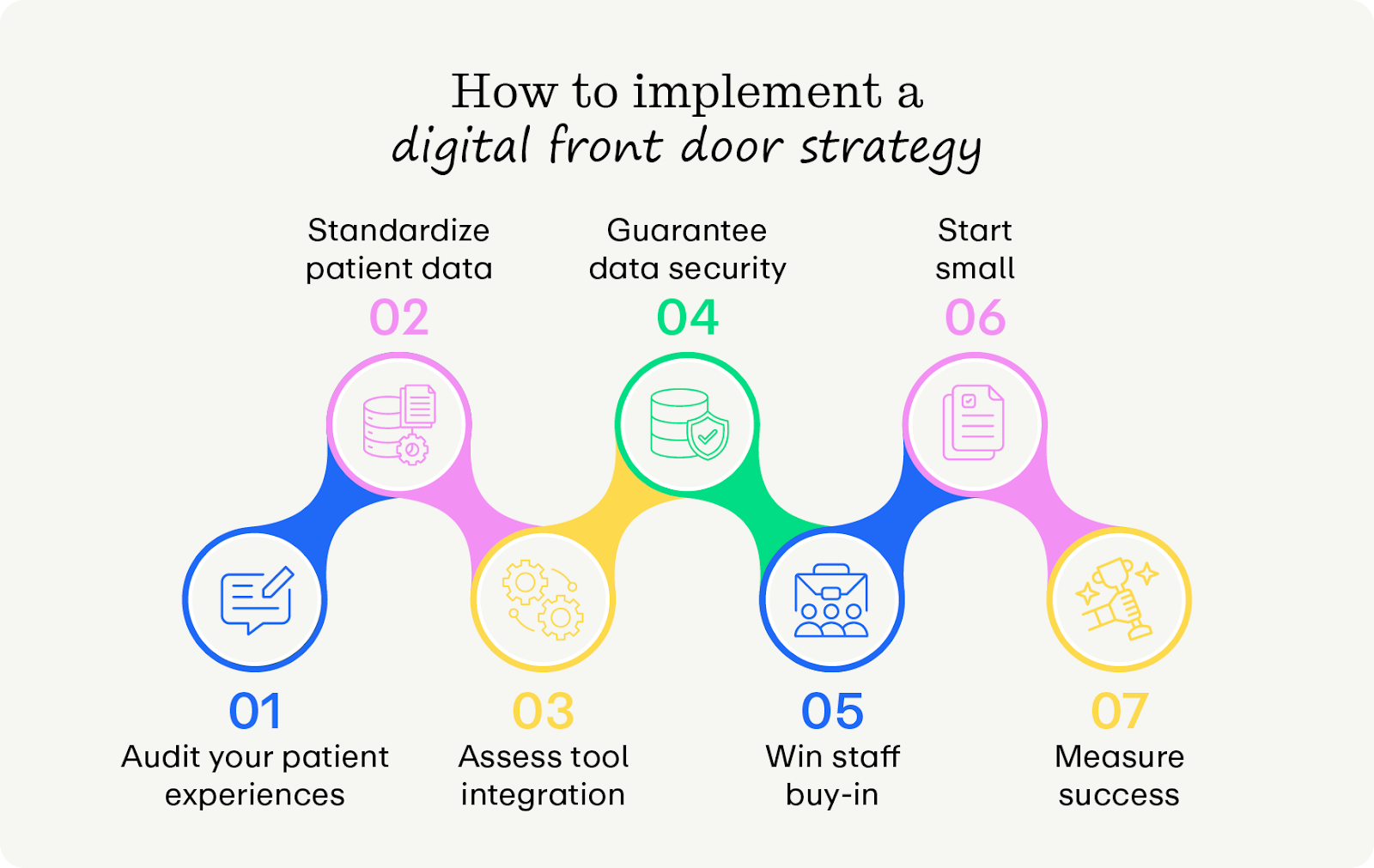
- Audit your patient experience. An effective action plan starts with a thorough audit of your current processes. Ask patients about what they like and dislike about your patient processes, from the convenience of requesting an appointment to the clarity of follow-up care instructions. Also, test the experience as if you were a patient—how long is the hold time? Is booking an appointment online efficient? Gather all of this data to inform your next steps.
- Standardize your patient data. To guarantee a consistent patient experience, you need consistent patient data profiles. Determine what data is important for your practice to collect (because a behavioral health clinic will likely need different information than an ophthalmologist). Then, conduct an audit of your current systems to gauge whether you can collect this data effectively. Finally, run a report of your current patient profiles to pinpoint any missing or outdated information.
- Assess tool integration. Your digital front door should be a holistic representation of your brand across multiple platforms, so it only makes sense that they communicate seamlessly with each other. For example, your Practice Management (PM) system should be able to sync patient engagement data directly with your communications system so patients only get the most relevant messages.
- Guarantee data security. Healthcare software solutions handle more sensitive data than the average CRM. Your digital front door tools must meet stringent security requirements to abide by HIPAA, specifically:
- PCI-compliant and SOC Type 2 security standards, ensuring patient payment and health data are heavily protected.
- Zero-retention data processing, guaranteeing that patient data is never used to train Artificial Intelligence (AI) models.
- Robust role-based access control (RBAC) and compliance with HIPAA and other relevant patient privacy regulations.
- Win staff buy-in. Your software will only achieve the intended impact if your whole team is on board. Create an implementation plan that helps staff get up to speed with your new tools without feeling overwhelmed. Provide a variety of materials to support your team (e.g., on-demand walk-through videos, live Q&A sessions, and a direct communication line to the implementation manager).
- Start small. If your digital front door optimization requires more comprehensive work, you might be looking at a months-long implementation and integration process. Instead of taking on a huge project all at once, break up your implementation into smaller, more manageable phases. For example, a healthcare system could first focus on implementing a digital intake and appointment scheduling module before adding a full patient portal. That way, your patients can adjust to the changes and your practice can continue running with minimal disruption.
- Measure success and KPIs. Establish the information you need to collect and how to collect it. For instance, you might track:
- Conversion rate of website visitors vs. appointments booked online.
- Call deflection rate before and after implementing AI assistants.
- No-show rate before and after implementing smart patient reminders.
- Payment received per patient before and after adding convenient digital payment portals.
- Pre-visit intake completion rate before and after adding smart digital intake forms.
What platform provides the best front door ecosystem?
While a complete digital front door strategy often integrates multiple disparate systems, some powerful platforms can offer greater all-in-one functionality. It’s best to prioritize these solutions to lighten the load on your team and guarantee seamless integration.
That’s where Promptly stands apart as a truly unified, user-friendly ecosystem that automates the entire patient journey. Our solutions:
- Rethink the legacy portal approach. Traditional portals fail because they rely on friction: app downloads, usernames, and forgotten passwords. Promptly replaces this outdated model with "Smart Links" sent via SMS. Patients verify their identity instantly with their date of birth—no login required.
- The result? Our friction-free approach delivers a 155% increase in pre-visit form completion compared to competitors. By removing barriers, practices also collect 94.2% of texted balances within 90 days.
- Prioritize automation over digitization. We don’t just move manual work to a screen; we eliminate it. Promptly’s logic engine handles complex tasks that usually require human intervention.
- Simplify online financial management. Promptly automatically collects payments, offers flexible payment plans, and facilitates insurance verification upfront. This allows staff to focus on complex cases and reduces the burden of manual collection efforts.
- Improve insurance estimates. Our system calculates precise out-of-pocket costs based on payer contracts before the patient arrives, driving an 85% increase in pre-service collections.
- Automatically manage scheduling: When a patient cancels, our automated waitlist instantly texts the next patient in line to fill the slot. This keeps your front door open 24/7, generating an average of $1.17 million annually in retained revenue for our users.
- Centralize many tools. A digital front door strategy’s success depends on how your tools work together. Promptly consolidates separate vendors for scheduling, payments, and intake into one suite so you can manage multiple tools in one place.
Our results speak for themselves: clients save an average of $88,000 annually in software fees and reclaim 1,728 staff hours per year. Promptly is built to ensure your digital front door remains open and accessible for your patients!
Additional resources
Just as you strive to make a great first impression when a patient walks through your physical front door, your digital presence should be built to impress. By critically evaluating and optimizing your digital front door, you give patients more control over their care and convert them into loyal members of your community. Plus, streamlining the processes that fall under your digital front door helps your staff devote more energy to what they’re really passionate about—providing great clinical care and connecting with patients.
Want to learn more about healthcare technology? Check out our educational resources:
- Master Insurance Eligibility Verification with These Tips. Master the complexities of insurance eligibility to ensure accurate claims and boost your practice's revenue with this guide.
- Digital Patient Intake Guide: Key Insights for Healthcare Practices. Learn how to leverage digital tools to streamline modern patient intake and enhance both efficiency and the patient experience
- Reduce Patient No-Shows by up to 90% with Smart Scheduling Tools and Custom Communications. Discover effective strategies and smart scheduling tools to help your practice cut patient no-shows by as much as 90%.
Ready to future-proof your practice?
Lock down time and revenue for your practice with Promptly’s comprehensive patient engagement suite.
Related Posts
About the author
Dr. Anish Kapur is a physician and tech entrepreneur advancing healthcare through innovation. He co-founded one of the first cloud-based EMR systems for specialists and now leads Promptly Technology Inc., whose Patient Experience Suite™️ helps specialty practices streamline workflows, boost patient engagement, and accelerate revenue—all in one modern platform.

Share this article:

We automate the tedious stuff so people can do the people stuff