.png)
15 Digital Patient Engagement Tools to Enhance Your Tech
Patients today expect a frictionless digital experience. Digital systems that manage everyday tasks have set the standard—in other words, booking an appointment with your practice should be as convenient as booking a flight or ordering groceries online.
Many healthcare practices still haven’t optimized their digital presence and tech stack, even though 85% of patients dislike repetitive paperwork and cumbersome wait times during the intake process.
However, the right digital engagement tools can alleviate those problems and more. By leveraging purpose-built systems made for patient engagement, your practice can provide a smooth experience from the moment they first discover your practice to when they pay their final bill. In this guide, we’ll explore everything you need to know about digital patient engagement tools: what they are, how they’re used, and how to best leverage them to exceed patient expectations (while providing exceptional care).
Table of Contents:
- FAQs about digital patient engagement tools
- Core digital patient engagement tools
- How to implement a new digital engagement tech stack
- Comparing top digital patient engagement tools and platforms
FAQs about digital patient engagement tools
What are digital patient engagement tools?
Digital patient engagement tools are software applications that healthcare practices use to communicate with patients, manage scheduling, facilitate intake, and process billing. We’ll get into the specific types of digital patient engagement tools later.
What is the hidden cost of disparate patient communication tools?
Historically, digital patient engagement tools were offered as point solutions—meaning a practice would buy a specific software to solve one specific problem, like sending SMS appointment reminders or collecting patient feedback.
While purpose-built systems help achieve specific tasks, layering separate point solutions can have drawbacks, including:
- Clunky workflow. Put yourself in the patient’s shoes—how would you feel if you had to sign up for multiple platforms just to schedule an appointment, pay your bill, and communicate with your doctor? The inconvenience can dissuade patients from returning to your practice (or even registering in the first place).
- Redundancy. While point solutions tend to have a single focus, they sometimes offer additional functionality that overlaps with the tools you already use. For instance, a patient scheduling software solution might also allow an ENT patient to message you directly, overlapping with your main communication solution. Finding the most efficient combination of tools adds more to your plate and can distract from patient care.
- Data silos. When your intake forms don't automatically sync with your scheduling or EHR software, patient information can slip through the cracks. This disconnect forces your staff to manually transfer data between systems, increasing the likelihood of transcription errors and frustrating patients who are repeatedly asked for the same medical history.
- Staff burnout. Expecting your front desk team to master and constantly toggle between several different applications just to process a single patient check-in is a recipe for fatigue. This administrative bloat slows down daily operations and pulls your staff away from providing attentive, face-to-face care.
- Subscription inefficiency. Paying monthly licensing fees, implementation costs, and ongoing support charges for disparate platforms quickly eats into your practice's bottom line. The perceived savings of buying a more affordable point solution are negated as your software subscriptions increase.
- Increased compliance risks. Healthcare practices have uniquely sensitive data to protect. Every new software vendor makes HIPAA and cybersecurity auditing much harder.
On the other hand, a unified patient engagement platform consolidates these functions into one system, providing a smooth experience. By centralizing all patient touchpoints, a unified platform serves as the bridge between patients and their Electronic Health Record (EHR, empowering patients to take control of their own healthcare journey through a single, intuitive interface and reducing admin work for staff.
How do digital tools improve patient engagement?
Digital tools improve engagement by removing friction from the care process, enabling patients to manage most administrative aspects of their appointments on their devices. When healthcare is accessible and user-friendly, patients are far more likely to take an active role in their treatment plans.
For example, let’s say you have an orthopedic patient coming in for lab work. Your patient engagement tool might send an automated pre-visit reminder to avoid eating before the appointment. After the appointment, the platform can automatically send a secure text link containing their lab results, along with a prompt to schedule a follow-up or pay any remaining balance. The result is a completely seamless, logical experience every time.
What is the difference between a patient portal and patient engagement software?
A traditional patient portal is often a static, disjointed repository tied directly to the EHR for viewing test results. Portals typically require patients to remember usernames and passwords, which harms adoption and results. Like a digital filing cabinet, these tools lack intelligent, interactive features that keep patients actively engaged.
In contrast, patient engagement software operates as an integrated system that facilitates dynamic interactions, like two-way texting and automated intake. Engagement software delivers the right information to patients at the right time through the channels they use every day. Unlike static portals, patient engagement software doesn't wait for patients to log in; it proactively guides them through their care journey to maximize interaction.
Are patient engagement tools HIPAA-compliant?
Yes, but the compliance burden scales with the number of vendors you use. Professional healthcare platforms must maintain strict HIPAA compliance by using encryption and secure access controls to protect sensitive patient data and health information. When practices use a patchwork of disparate tools, they must sign and manage multiple Business Associate Agreements (BAAs), track numerous user access logs, and audit several different systems for security vulnerabilities.
Implementing a unified platform simplifies compliance audits by centralizing data security. Reducing the risk of data breaches and relying on a single, highly secure software system makes it easier to protect data from end to end.
Core digital patient engagement tool capabilities
A digital front door in healthcare refers to the unified, omni-channel strategy and technology that engages patients at every major touchpoint of their care journey. Instead of making patients juggle different apps, portals, and phone numbers, a unified digital front door consolidates these experiences into a single, seamless interface (usually a mobile app or comprehensive web portal).
Here are the core features that make up a fully unified digital front door for healthcare practices:
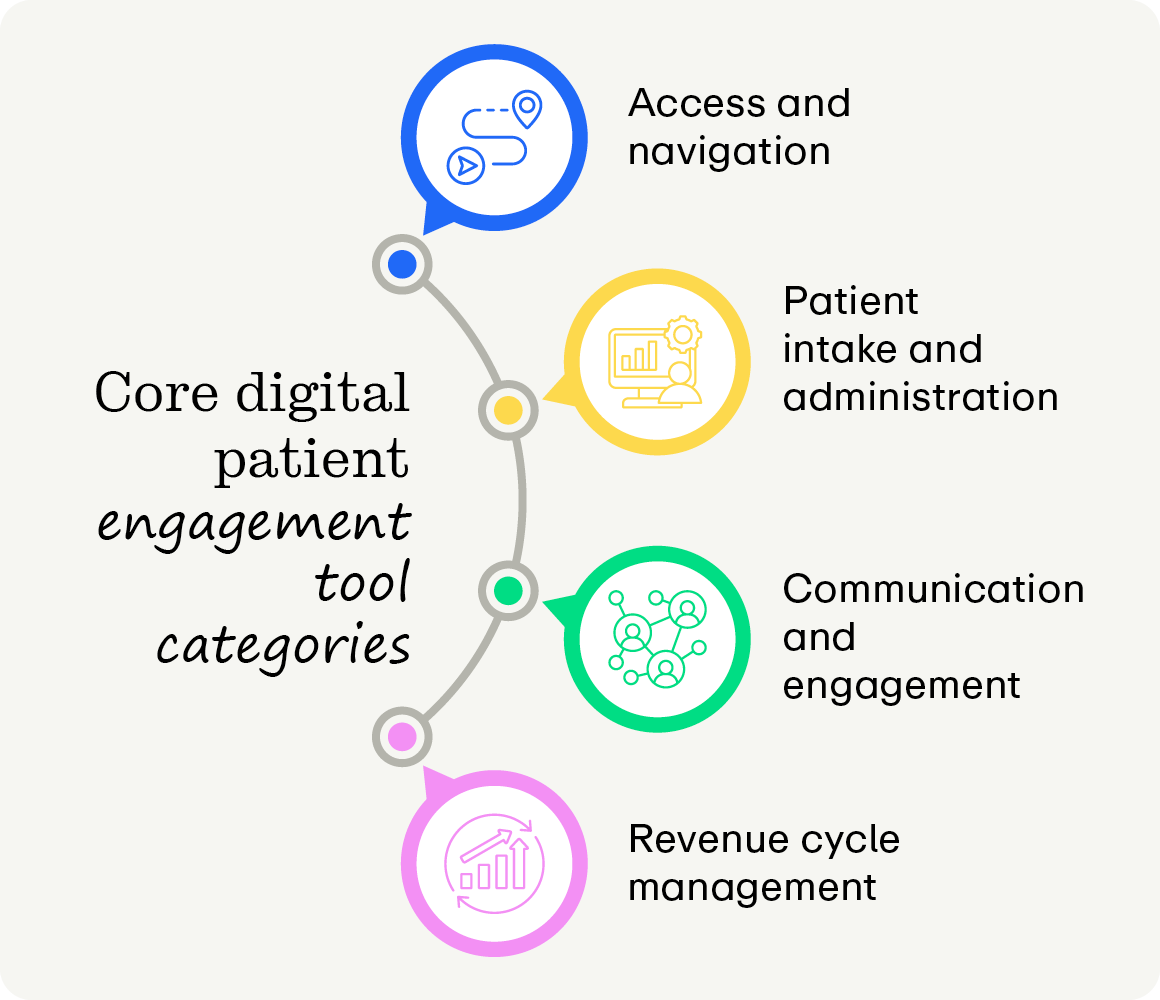
Access and navigation
- Self-directed appointment booking: Patients can autonomously manage their calendar events (booking, canceling, or rescheduling) around the clock without needing to call the clinic. Plus, waitlist automation immediately offers canceled slots to waiting patients via text.
- Intelligent provider matching: Smart algorithms that replicate front-desk workflows to successfully guide even new patients to the appropriate provider and visit type without staff intervention.
- Care and referral coordination: Dedicated physician liaison tools and online portals that facilitate continuity of care by allowing referring providers to easily submit patient documents and book appointments directly into the specialist's schedule.
Patient intake and administration
- Digital registration and forms: Enable patients to complete intake forms and update medical history on their own devices before they arrive at the office.
- Automated insurance verification & OCR: Systems that use AI, Optical Character Recognition (OCR), and barcode scanning to capture images of insurance cards and IDs, instantly extracting data to eliminate manual entry. The best insurance verification systems also run automated Real-Time Eligibility (RTE) checks to verify active coverage, co-pays, and deductibles prior to the visit.
- Explanation of Benefits (EOB) management: AI assistants that digitize paper EOBs and automate Electronic Remittance Advice (ERA) payment posting, reducing manual administrative entry.
Communication and engagement
- Secure two-way messaging: These features allow patients to communicate directly with their care team or administrative staff through secure, login-free two-way texting.
- Automated reminders and broadcasts: Send omnichannel notifications (SMS, email, and IVR voice calls) for upcoming appointment confirmations, personalized pre-visit education, preventive care gaps (like overdue recalls and reactivations), and post-visit follow-ups.
- Patient education delivery: Automated distribution of customized educational content and videos before or after an appointment so patients are fully informed about their upcoming care or recovery.
- Personalized outreach: Highly customizable communication strategies, such as automated drip campaigns and specific messaging sequences tailored to individual patient profiles without character limits.
- Post-visit and post-discharge follow-ups: Automated messaging workflows initiated after an appointment or procedure to check in, provide clinical notes, and offer recovery guidance.
- Feedback and feedback requests: Intelligent post-visit surveys consisting of three simple questions to monitor patient satisfaction internally, while automatically routing satisfied patients to public review sites to boost practice visibility.
Revenue cycle management (RCM)
- Integrated patient financing: Promptly integrates directly with CareCredit, running automated "Quick Screens" before appointments to identify pre-approved financing options, empowering patients to afford out-of-pocket costs and easing financial conversations for your staff.
- Price transparency and copay alerts: Tools that produce accurate Patient Cost Estimates (PCE) using payer contracts, ensuring patients are fully aware of their out-of-pocket responsibilities and copays prior to their visit.
- Consolidated payment processing: Unified billing systems supporting virtual wallets (like Apple Pay or Google Pay), customized payment plans, and financial management tasks.
- Automated payment reminders: Login-free, text-to-pay alerts that proactively notify patients of their outstanding balances, making it incredibly simple to settle debts immediately without navigating a clunky portal.
It’s not enough for your digital front door to just have all of these features. A true digital front door seamlessly integrates all of these capabilities and layers on top of the practice's practice management (PM) systems, organizing and syncing data in real time so patients and staff don’t have to duplicate their efforts.
Promptly offers all of these features—want to try them for yourself?
How to implement a new digital engagement tech stack
Implementation looks different depending on your starting point and desired end-state. However, regardless of your goals, your process will likely start with replacing separate point solutions with a comprehensive engagement platform that unifies workflows.
Here is a strategic roadmap to successfully roll out a cohesive digital patient engagement platform:
.png)
1. Audit the current patient journey and tools
Before introducing new technology, you need to understand exactly where your current bottlenecks lie. Track a hypothetical patient from the moment they search for your clinic to the day they pay their final balance. Document every touchpoint, identifying which siloed point solutions, third-party portals, or manual clipboards are currently handling critical tasks. Then, compare this information with the annual subscription costs and manual hours spent managing these separate applications. That way, you’ll identify redundancies and build a strong business case for consolidation.
2. Select an end-to-end unified platform
Look for a comprehensive digital front door—like Promptly—that centralizes the entire patient lifecycle into one cohesive ecosystem. Your chosen platform should be able to handle self-service scheduling, passwordless digital intake, two-way conversational messaging, and mobile payment processing natively.
3. Prioritize EHR integration
A new tech stack relies on your EHR to operate on accurate data. Surface-level integrations that require staff to manually approve, download, or transcribe data will only create more headaches.
Ensure your new engagement platform automatically syncs with your EHR, and vice versa. This means it can both pull real-time schedule availability from the EHR and automatically log intake forms, demographic updates, and payment records directly into the patient's chart without any human intervention.
4. Train your staff
Introducing new tech can be disruptive and overwhelming if not handled with care. Your team needs to understand how this transition directly benefits them.
Shift their focus away from the anxiety of learning a new system and instead highlight the benefits of your new tools (e.g., time savings, more efficient workflows). Once you’ve established expectations for the new system, thoroughly train your front desk, clinical, and billing teams to use it for their respective roles. Throughout the process, communicate clearly with staff to ensure they feel supported and confident enough to use the tool independently faster.
5. Roll out new tech to patients
Once your staff is comfortable with your new tech stack, introduce the modernized digital experience to a segment of your patients. This pilot phase allows you to pinpoint any gaps your staff may have missed and correct them before rolling out your tools to all your patients.
When your tools are in good shape, update your practice's website to highlight your new features and send an introductory campaign explaining the transition. Emphasize the immediate conveniences and offer support documents to help with the transition (e.g., FAQ guides, links to resources from the tech vendor, and a feedback form).
Comparing top digital patient engagement tools and platforms
It’s important to understand your digital engagement tool’s features before investing. Take a look at how the features of the top digital engagement tool, Promptly, stack up with other tools:
Why Promptly is the top digital patient engagement platform
Promptly provides an end-to-end platform designed to eliminate the administrative burden of disjointed systems. By replacing outdated legacy software with Promptly, practices unlock a complete operational ecosystem alongside next-generation AI capabilities, including features like:
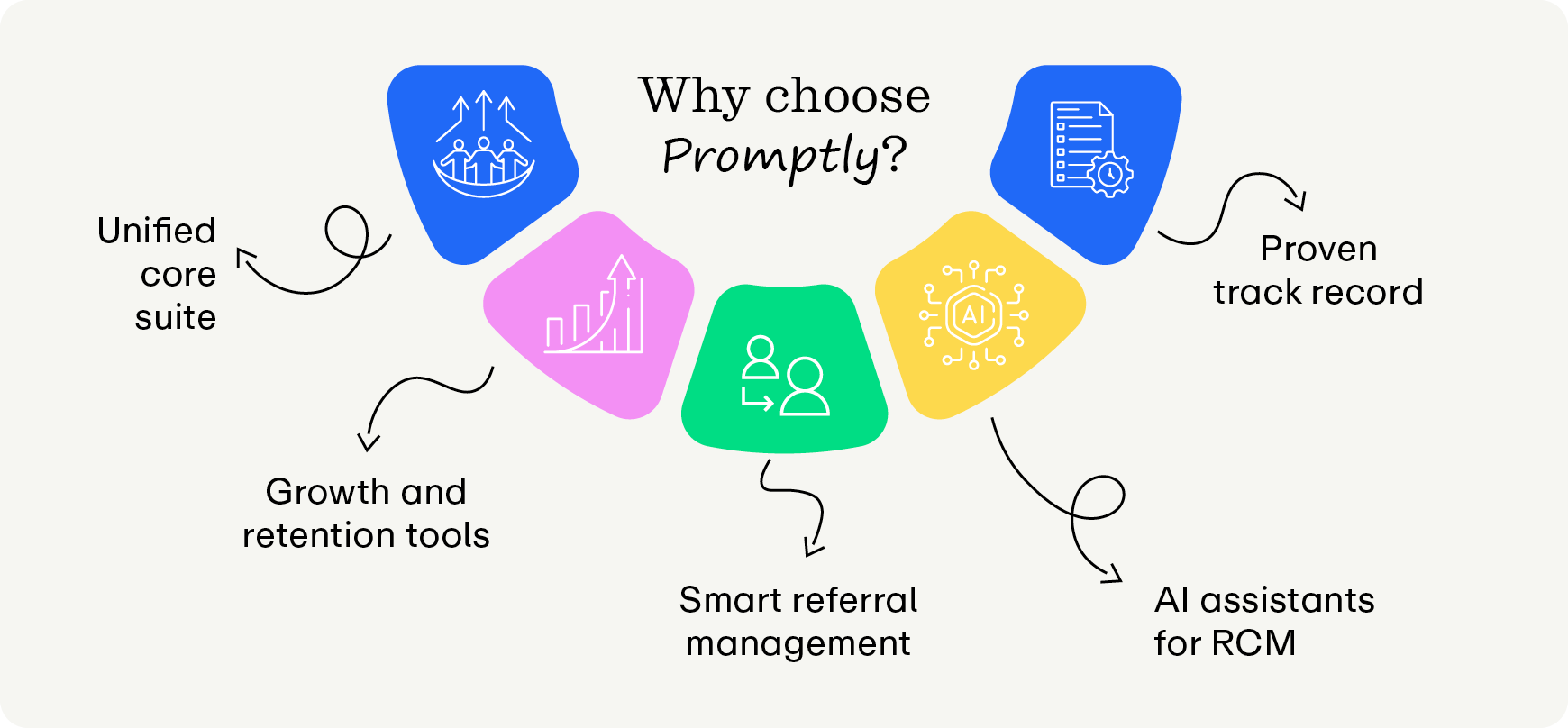
- Unified core suite: We bring your entire front office workflow under one roof with natively integrated tools for self-service scheduling, streamlined intake, seamless data management, and real-time insurance verification.
- Growth and retention tools: Keep your practice thriving with automated features that handle two-way patient communication, transparent billing and payments, relationship building, and even online reputation management.
- Smart referral management: Stop chasing down lost paperwork. Our referral portal comes equipped with AI Fax, instantly converting unstructured paper documents into actionable data.
- (Coming soon) AI Assistants for RCM: We are transforming RCM through end-to-end automation, from patient intake to payment posting. These intelligent agents will deploy across every RCM touchpoint, automating complex workflows and eliminating millions of manual hours with these agents:
- Prior Authorization Specialist: Automates submissions 24/7 to stop front-end denials.
- EOB & ERA Payment Posting Assistant: Instantly digitizes paper EOBs, cutting manual data entry by up to 90%.
- Insurance Discovery Agent: Automatically finds hidden coverage to turn self-pay into collectible revenue.
- Drug Benefit Investigation Detective: Automates complex benefit investigations from high-cost injectables to step-therapy.
- Proven track record: Practices using Promptly generate an average of $1,170,000 annually just by filling schedule gaps through automated waitlists, referrals, and reactivations. Plus, the average Promptly user saves 1,728 staff hours per year by automating tedious workflows such as manual data entry and phone calls.
Additional resources
Leveraging a connected, user-friendly network of digital patient engagement tools (or, better yet, a centralized patient engagement platform) is essential not only to thrive as a business but also to deliver quality care and improve health outcomes for your patients. As long as you take a strategic approach and strategically choose the best tools for your needs, you’ll be able to keep up with the ever-evolving field of patient engagement technology.
Learn more about healthcare tech with these free guides:
- Patient Satisfaction Surveys: Tips and 40+ Questions to Ask. Understanding what your patients think of your practice is critical for improving your care. Get started with patient satisfaction surveys.
- Hidden Costs of Fragmented Healthcare Software—and How to Resolve Them. Disjointed tech stacks have several sneaky revenue pitfalls that can severely harm your practice. Learn how to avoid them in this guide.
- Healthcare Software Consolidation: Benefits of Integrating Multiple Platforms. Ready to switch to an end-to-end patient engagement platform? Launch your new approach in this guide.
Ready to future-proof your practice?
Lock down time and revenue for your practice with Promptly's comprehensive patient engagement suite.
Related Posts
About the author
Greg Grasso has been in the healthcare industry for over a decade, helping practices of all subspecialties exceed their business goals while improving their patient experience by utilizing innovative technologies and automation systems. Greg previously worked as the director of enterprise solutions within one of the largest ophthalmology-specific software companies in the country.

Share this article:

We automate the tedious stuff so people can do the people stuff