.png)
Insurance Verification Software: A Health Practice Guide
Running a successful medical practice is incredibly rewarding, but managing the endless cycle of administrative paperwork can quickly drain your team's energy. At the heart of this challenge is insurance verification—a task that is critical for securing revenue, but has traditionally required hours of manual labor.
That’s where insurance verification software comes in. Transitioning to dedicated insurance verification tools is one of the smartest upgrades a modern practice can make to protect its bottom line. By automating eligibility checks, you can drastically reduce front-desk bottlenecks, minimize costly billing errors, and keep your cash flow steady.
In this guide, you’ll discover the essential features to look for, strategic tips for choosing the right platform, and the best solution available today. Let’s dive into how this technology can help your team reclaim time and focus on what you do best: taking care of patients.
Table of Contents
- FAQs about insurance verification software
- How to choose insurance verification software
- Promptly: The best insurance verification software

FAQs about insurance verification software
What is insurance verification?
Insurance verification is the process of confirming a patient’s insurance policy activation status, the specific procedures and appointments it covers, and the copay that the patient is responsible for. Insurance verification matters because it:
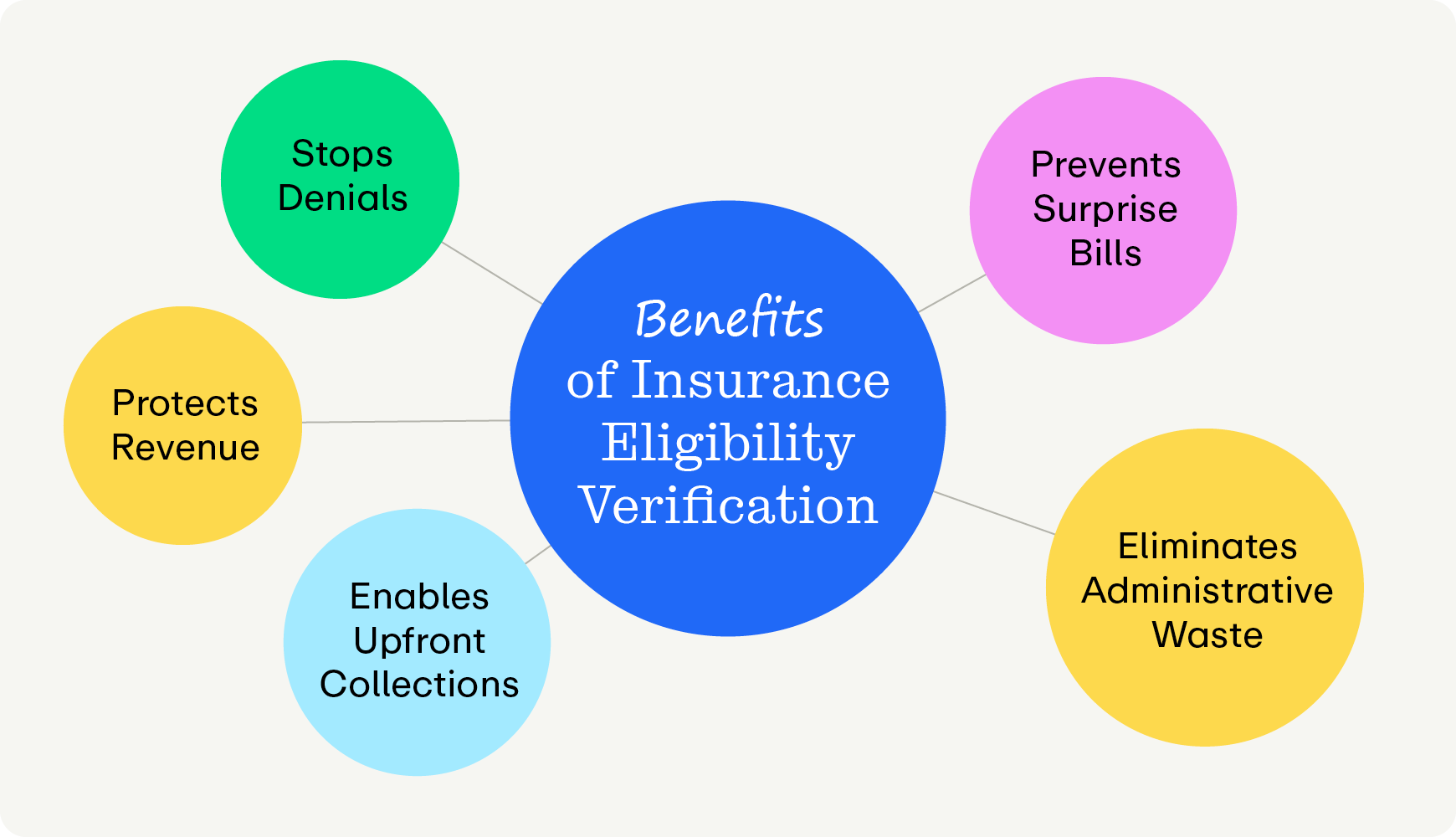
- Stops denials
- Protects revenue
- Enables upfront collections
- Prevents surprise bills
- Eliminates administrative waste
What is insurance verification software?
Insurance verification software is a set of digital tools that automates insurance verification tasks. You can think of these tools as a digital bridge between your practice's scheduling system and health insurance providers. Instead of requiring your front-desk staff to pick up the phone, wait on hold, or log in to dozens of insurance portals, this software automates the entire inquiry process.
What are the differences between manual and automated insurance verification workflows?
Manual insurance verification is costly, both in overhead and in team time. On average, a front-desk team member spends roughly 10 to 15 minutes per patient verifying benefits manually. If your practice sees 40 patients a day, that amounts to a whopping 10 hours of lost productivity every single day spent on repetitive administrative work.
Beyond the labor costs, manual verification is vulnerable to human error. When verifying insurance manually at scale, it’s easy to mistype a single character in a policy ID or miss a subtle rule change in a payer's policy. Industry data show that registration and eligibility errors account for 15-30% of all medical claim denials. When a claim is denied weeks after care was delivered, your billing team has to spend extra time appealing the claim or chasing down the patient for an unexpected balance, which frequently turns into uncollectible bad debt and a lost patient.
Meanwhile, using insurance verification software removes all the risk and daily resources spent on the process. Insurance verification platforms confirm a patient’s eligibility and status with just the click of a button; the best solutions even run real-time checks in the background without staff intervention. The tools then flag any discrepancies or other issues to the front desk, preventing them from compounding and ensuring a better patient experience.
Toggle between these two workflows to see the difference in action:
How does automated insurance verification prevent prior authorization and claim denials?
While basic eligibility checks confirm that a patient has an active policy, advanced insurance verification software bridges the gap between simple coverage status and the complex rules of medical billing. This is especially critical for prior authorizations—the formal process in which a payer must explicitly approve a specific treatment, service, or Current Procedural Terminology (CPT) code before care is delivered to demonstrate medical necessity.
When it comes to protecting your revenue cycle, automated software serves as an intelligent early-warning system. By automatically running deep verification checks days before an appointment, the system flags authorization requirements and billing hurdles while your staff still has plenty of time to resolve them.
This is how the software prevents prior authorization penalties and front-end claim denials:
- Automated insurance code cross-referencing. The software automatically screens the scheduled procedure's CPT codes against the payer’s real-time rules database, instantly alerting your team if a formal prior authorization or referral is required for that treatment.
- Proactive status and reference tracking. The system monitors the progress of pending authorizations and automatically links approval reference numbers to the scheduled appointment, ensuring the mandatory codes are present on the claim to prevent immediate missing authorization rejections.
- Pre-visit verification of payer-specific exclusions. By checking granular plan details several days in advance, the software catches plan-specific exclusions, non-covered services, or medical-necessity requirements before spending clinical resources, preventing preventable medical claim denials.
How to choose insurance verification software
Investing in new software is a big decision that impacts your daily operations, financial performance, and the patient experience. Keep these strategic principles in mind to make the best choice for your practice.
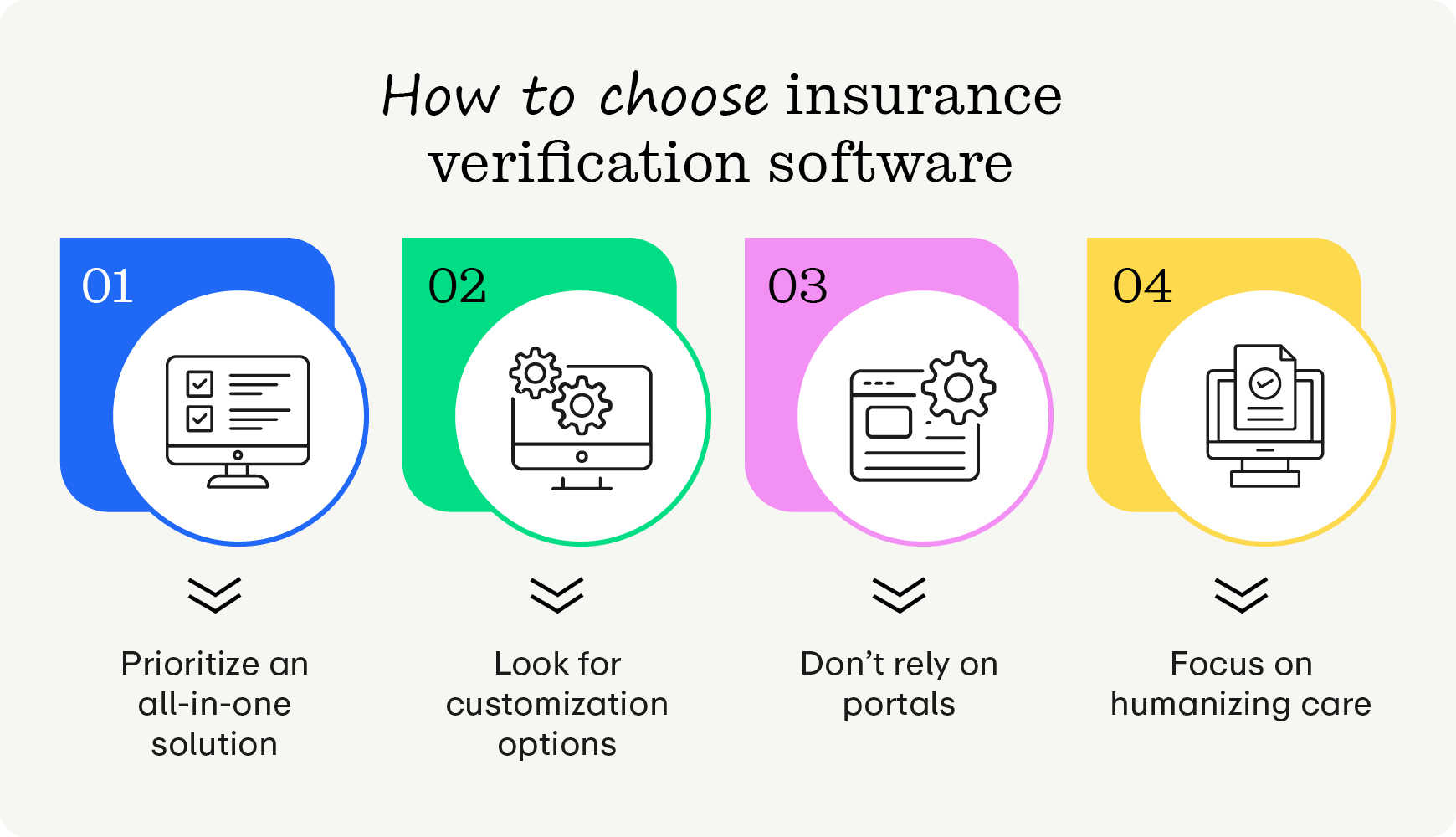
Prioritize an all-in-one solution
Many practices inadvertently create operational headaches by buying standalone software for every single task, from insurance verification to scheduling to intake management. This approach forces your team to manage multiple logins, navigate completely different user interfaces, and contact different support teams for troubleshooting.
Instead, look for a platform that centralizes these features into a single solution. When your insurance verification tool is a native part of your scheduling and patient intake software, data flows seamlessly through the entire workflow. This approach eliminates communication silos and lowers your practice's total IT overhead.
Look for customization options
Many software options on the market are designed for general primary care practices. However, specialty practices have distinct billing rules and workflows that generalized software isn’t equipped for. For example, an eye care practice may have to check both medical insurance and specialized vision plans, while an orthopedic or physical therapy practice might have strict visit limits or complex authorization thresholds. Always choose a platform built with the flexibility to adapt to the specific rules and nuances of your medical specialty.
Don't rely on portals
If your software requires a patient to create a username, remember a secure password, or download a brand-new smartphone app just to share their insurance card, it’ll jeopardize your patient retention rates.
Modern patients appreciate simplicity, which is why a portal-free digital experience matters. This means the system can send a secure, encrypted link directly to the patient via text message or email. The patient simply taps the link, snaps a quick photo of their insurance card on their phone, confirms their basic details, and submits it—all in under a minute, without any clunky downloads.
Focus on humanizing care
Technology should never feel like a wall between your staff and your patients. The ultimate goal of automating administrative busywork is to give your team their time back so they can focus on delivering warm, personal, face-to-face patient care. By taking the stress out of insurance checks and eliminating unexpected financial surprises, your front-desk team can interact with patients confidently and empathetically, enhancing the overall patient experience.
Promptly: The best insurance verification software
If you are looking for a comprehensive, specialty-tailored platform that surpasses the industry standard, Promptly is the industry-leading option. Engineered to simplify the patient journey and maximize financial performance, Promptly provides an intuitive, automated approach to revenue cycle management (RCM). Here are just a few features that make our platform stand out:
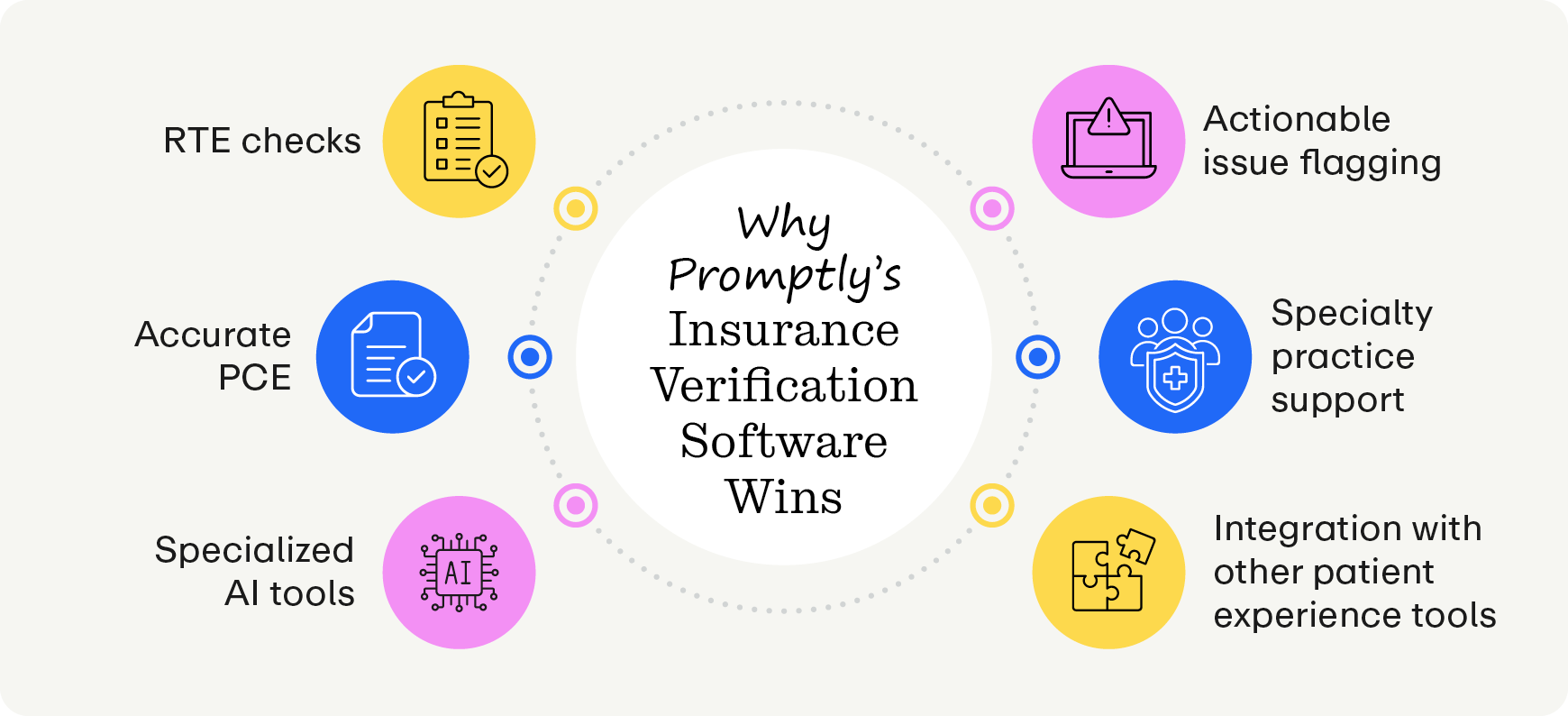
RTE checks
Promptly’s powerful RTE Worklist takes the guesswork out of checking patient benefits. With a clean, central interface, the system pulls comprehensive insurance data instantly and can run up to 2 months in advance, giving your administrative team clear visibility into:
- Exact co-pays and co-insurance responsibilities
- Breakdowns of total and remaining deductibles
- Real-time out-of-pocket maximum statuses
- Specific prior authorization and referral alerts
- In-network vs. out-of-network coverage boundaries
Promptly also runs stress-free, handling your eligibility tasks behind the scenes. We automatically scan your practice calendar and run proactive verification checks every day, starting up to 10 days before a patient’s scheduled appointment. When Promptly runs, it adds at-a-glance star icons and plan-type tags to make data scouring more efficient.
By catching terminated policies, coverage changes, or coordination-of-benefits issues well ahead of time, Promptly reduces the time your staff spends manually verifying and correcting insurance records by 60%. This early notice gives your team plenty of time to resolve errors before the patient arrives.
Actionable issue flagging
When an insurance issue pops up, Promptly ensures your team knows exactly how to handle it. The platform highlights affected accounts on a color-coded central dashboard and translates complex payer codes into clear, actionable advice and tags. Whether a policy is inactive or there's a simple typo in a subscriber ID, Promptly spells out the issue clearly so your staff can address it quickly and accurately. Plus, once an issue is flagged, you can text the patient right from the platform to confirm coverage, all from the same app. Here are some of Promptly’s conflict tags:
- Name mismatch
- Out of network
- Coordination of benefits
- Primary/secondary mismatch
- General conflict
- Auth/certification required
Accurate PCE
Promptly makes financial conversations with patients straightforward and transparent. By matching live, real-time eligibility data directly with your practice's contracted payer fee schedules, physician fees, and billing histories, Promptly generates precise, itemized PCEs.
These clear estimates are automatically shared with patients digitally before their appointment, driving an anticipated 85% increase in pre-surgery collections and eliminating surprises in post-visit billing.
Specialty practice support
For multi-specialty practices, managing medical insurance and specialized vision plans simultaneously can be a major headache. Promptly helps with specialized, AI-powered automation built explicitly to navigate major vision insurance carriers. The software automatically checks vision benefits and retrieves authorizations in the background, saving your staff from constant portal hopping.
Specialized AI tools
As part of Promptly’s RCM tools, Promptly offers a specialized AI-powered tool for insurance verification. The Insurance Discovery Agent automatically checks your database for hidden or updated patient coverage and corrects issues.
Beyond insurance verification, Promptly also offers a Prior Authorization Specialist tool that automates the entire submission-to-approval process. By handling pre-authorizations automatically, it stops front-end claim denials and protects practice revenue before the patient even arrives for their visit.
Integration with other patient experience tools
Promptly is an all-in-one patient experience suite that enhances all aspects of your practice’s digital front door. Some of our platforms’ other features include:
- Patient Engagement Software
- Patient Appointment Scheduling Software
- Patient Intake Software
- Patient Data Management Software
- Insurance Verification Software
- Referral Management Software (add-on)
- Healthcare Reputation Management (add-on)
- Patient Communication Software
- Patient Payment Software
- Patient Relationship Management
- Referral Portal with AI Fax (add-on)

Additional resources
Embracing smart administrative automation is one of the most effective ways to position your medical practice for long-term success. Continuing to rely on manual phone calls, disconnected spreadsheets, and tedious portal logins places an unnecessary burden on your staff and exposes your practice to avoidable claim denials.
By implementing a modern, comprehensive insurance verification software solution like Promptly, you'll cut administrative workloads by 60%, protect your hard-earned revenue from preventable billing rejections, and give your team the peace of mind they need to deliver excellent, patient-centered care.
- Patient Satisfaction Surveys: Tips and 40+ Questions to Ask. Patient satisfaction surveys are essential for aligning your practice with patient expectations. Discover how to optimize your patient surveys in this guide.
- The Definitive Patient Engagement Software Buyer's Guide. There are many patient engagement software solutions on the market. Use this guide to find your ideal solution and streamline your practice’s operations.
- 15 Digital Patient Engagement Tools to Enhance Your Tech. Healthcare practice managers need to use cutting-edge digital patient engagement tools to secure loyal patients. Learn more in this healthcare tech guide.
Stop guessing and start collecting.
Try out Promptly’s Real-Time Eligibility tool today.
Related Posts
About the author
Dr. Anish Kapur is a physician and tech entrepreneur advancing healthcare through innovation. He co-founded one of the first cloud-based EMR systems for specialists and now leads Promptly Technology Inc., whose Patient Experience Suite™️ helps specialty practices streamline workflows, boost patient engagement, and accelerate revenue—all in one modern platform.

Share this article:

We automate the tedious stuff so people can do the people stuff