Healthcare Reputation Management: 6 Steps to Build Trust
Building strong relationships is the foundation of any growing business, but it carries far more weight in medical clinics. Patients often enter healthcare practices with anxiety—in fact, nearly 50% of people experience stress before going to the doctor. To alleviate that hesitation, you need to create a positive, comforting impression from the very first moment they look up your practice online.
Healthcare reputation management helps you build that trust. By intentionally shaping how your clinic appears online and delivering a stellar patient experience in the office, you establish a solid standing in your community. Your online presence can make all the difference—75% of patients refuse to book an appointment with a provider rated below 4.0 stars.
In this guide, we’ll explore what healthcare reputation is, why it matters, and how to build a stellar brand. Ultimately, you’ll be able to translate that brand into patient loyalty and sustainable financial growth.
- FAQs about healthcare reputation management
- Healthcare reputation management best practices
- The best healthcare reputation management platform: Promptly

FAQs about healthcare reputation management
What is healthcare reputation management?
Healthcare reputation management is the strategic practice of monitoring, gathering, and shaping public patient sentiment through automated post-visit feedback, recovery-aligned survey delays, and communication workflows. Some healthcare reputation management tactics include:
- Collecting and strategically routing feedback. You can privately reach patients with a quick post-visit text survey to gauge their feedback; if they give you a positive review, the tools automatically route them to leave a 5-star review on Google, whereas negative reviews get routed to your team for internal service recovery.
- Timing outreach to clinical recovery. Tactically schedule your post-appointment outreach to give patients time to properly recover from procedures before you ask them to evaluate their experience, showing your care for their well-being.
- Mentioning specific providers in messaging. Highlight the specific doctor the patient saw in your feedback requests to humanize the communication and boost positive response rates.
- Monitoring your digital reputation. Consistently tracking and responding to digital reviews across platforms such as Google, Healthgrades, and ZocDoc demonstrates to the community that your clinic values patient input.
What are the benefits of healthcare reputation management?
Proactive image management boosts more than your online star rating. Practices experience these benefits with a strong strategy:
- Protected practice revenue. As previously mentioned, maintaining a star rating above 4.0 prevents significant patient drop-off. A strong reputation is essential for patient acquisition and retention.
- Strengthened local search visibility. High review volume and consistent ratings signal authority to Google, driving organic traffic to your practice without paid advertising.
- Unified patient communications. Using specialized reputation management software centralizes review tracking, patient communication tools, and reporting on a single platform, simplifying the experience for both your team and the patients submitting reviews.
- Boosted staff morale. Monitoring and reporting on real-time positive feedback gives administrators clear data to celebrate staff performance and eliminate operational headaches.
- Improved insight into team performance. Reviews also provide practice management with specific areas for improvement from the patient’s perspective that your internal team may have missed.
What goes into building a healthcare practice’s reputation?
Many internal and external aspects of your practice shape its image, including:
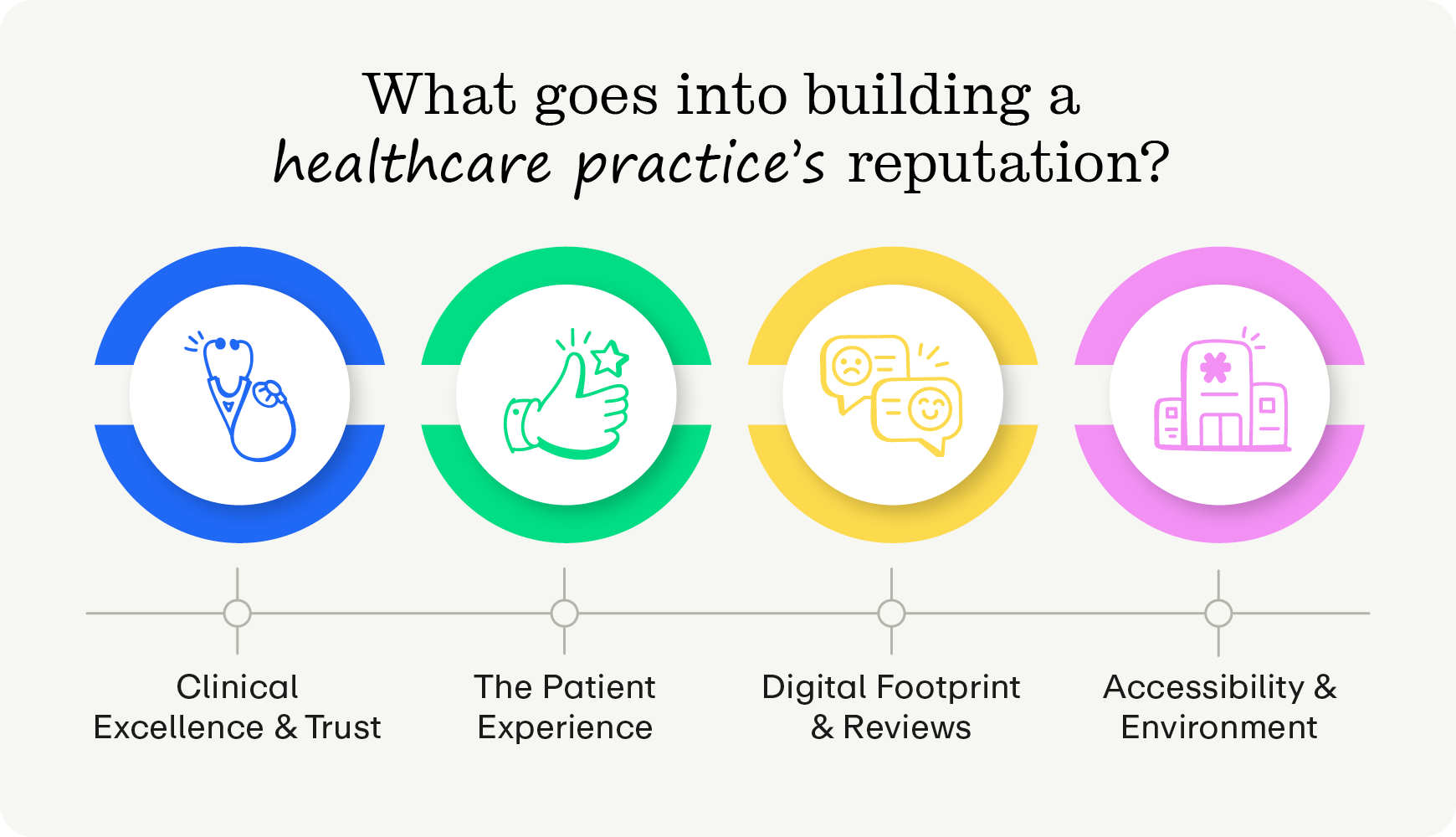
Clinical Excellence & Trust
- Quality of care: Consistent, positive health outcomes paired with a strict prioritization of patient safety are the foundation of any reputable clinic.
- Provider bedside manner: Doctors build trust by listening with genuine empathy while translating complex medical jargon into everyday language.
- Transparency: Patients expect complete honesty about their clinical options and anticipated out-of-pocket costs before an appointment or procedure.
The Patient Experience
- Staff interactions: The entire support team, from the front desk to the billing department, leaves a lasting impression based on their overall warmth and professionalism.
- Wait times: Demonstrate respect for a patient's schedule shines through by minimizing delays and communicating proactively if a provider is running behind.
- Communication: Whether it involves a prompt phone call about lab results or simply being easily reachable for prescription refills, accessible communication reassures your patients.
Digital Footprint & Reviews
- Online reviews: By actively monitoring the feedback left on public platforms, administrators can effectively address both praise and criticism.
- Digital presence: An intuitive website acts as a digital front door where prospective patients can easily discover your clinic's offerings and doctors' backgrounds.
Accessibility & Environment
- Convenient, efficient operations: Modern conveniences are practically essential today, so practices should adopt patient engagement tools for self-serve scheduling, virtual visits, and two-way communication.
- Facility atmosphere: A clean physical space with comfortable seating signals high-quality, detail-oriented care and professionalism to anyone walking through the doors.
How can practices gauge their reputation?
Getting a complete picture of your practice’s reputation helps you identify strategy gaps and what’s working well. Here’s how to get started:
- Track external benchmarks. Keep close tabs on star ratings, monthly review volume, the number of patients acquired from reviews, and sentiment trends across public review platforms. You can also analyze these metrics alongside your overall patient acquisition and retention metrics to gauge any related trends. These metrics will reveal local market standing and areas for improvement.
- Analyze informal community sentiment. Dedicated review boards aren’t the only forum to gauge public opinion. Unfiltered discussions frequently occur in local Facebook groups or neighborhood apps like Nextdoor, so your staff should add these to your platform audits.
- Leverage frontline observations and loyalty indicators. Receptionists and medical assistants see candid patient reactions during everyday interactions. A formalized Net Promoter Score (NPS) tracks long-term brand advocacy, which complements those internal anecdotal reports from your support staff.
- Evaluate internal response metrics. Measure satisfaction survey completion rates and provider-specific satisfaction scores across all clinic locations. Comparing satisfaction metrics across locations identifies specific training needs.
- Monitor real-time administrative dashboards. Centralized dashboards give practice leadership immediate visibility into patient sentiment, allowing rapid intervention before negative feedback reaches public forums. Real-time alerts empower managers to resolve issues instantly—and early detection can make a big difference in your reputation.
- Assess professional referral volume. Recommendations from other local physicians serve as a powerful barometer for your clinical standing within the broader medical community. Any sudden shift in incoming patients from primary care doctors or specialists usually points to underlying changes in peer perception.
Healthcare reputation management best practices
Bolstering your healthcare practice's image requires ethical, recovery-aligned outreach strategies. These practices allow specialty clinics to capture authentic positive reviews on Google while privately resolving negative experiences to protect patient trust.
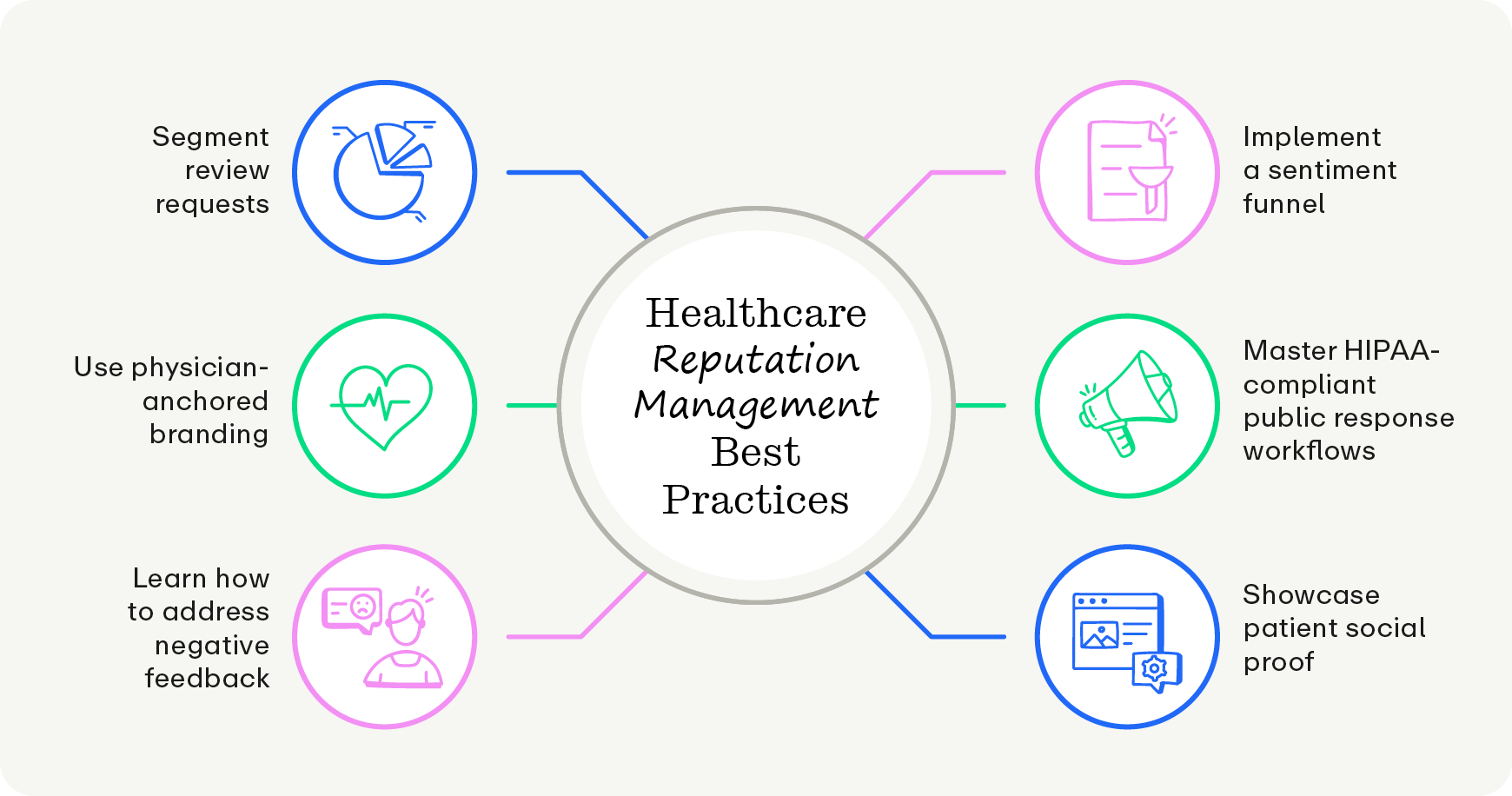
1. Segment review requests
If organic reviews are stagnant, your practice can solicit reviews yourself—but you need an intentional strategy in place first.
The main consideration here is procedure/visit type. Don’t treat a routine consultation the same way you would a complex surgical procedure when asking for feedback. It can come off as insensitive if your practice reaches out for feedback while a patient is still healing from major surgery. Rely on historical average recovery timelines or ask the patient how they’re doing to plan the ideal time to reach out.
You may also use these segments when requesting feedback:
- New versus established patient status
- Specific provider or care team
- Appointment modality (telehealth versus in-person)
- Physical clinic location or facility
- Initial internal survey sentiment (e.g., NPS promoters)
2. Implement a dual-path sentiment funnel
Manually reading and classifying patient sentiment isn’t sustainable for busy practices. Fortunately, the best healthcare reputation management tools make it easy to record and respond to patient feedback. Here’s how these tools usually work:
- The system sends automated, timed post-visit outreach. For routine visits, the tool automatically triggers review requests via SMS or email immediately after the visit. Practices can segment delivery rules by appointment type so outreach arrives when patients are most receptive.
- Patients receive a brief survey to complete. Instead of exhausting patients with long questionnaires, the system deploys a simple thumbs-up or thumbs-down prompt paired with a standardized survey in which they rate the overall practice, the treating doctor, and their experience. Personalizing this outreach with the treating provider's photograph builds an immediate personal connection and encourages patients to leave detailed comments.
- The system reads the reviews and funnels it accordingly. When a patient provides positive feedback, the tool’s intelligent sentiment logic automatically prompts them to post a 5-star review on public platforms. Conversely, if a patient reports a negative experience, the platform privately routes their concerns to an internal feedback form and notifies clinic administrators, allowing them to address operational or clinical issues before public brand damage occurs.
- Practice administrators view reports in a review dashboard. Practice leadership tracks public reviews across multiple channels (such as Google My Business, Healthgrades, WebMD, RateMDs, and Facebook) from a single dashboard. Then, practice staff can submit direct, HIPAA-compliant replies using pre-approved message templates.
Pro-tip: These tools not only position your practice to collect great reviews now, but also set the foundation for better patient experiences long-term. We’ll review the best reputation management software solution later.
3. Humanize your requests with physician-anchored branding
Personalizing review requests with provider branding significantly increases conversion rates by tapping into established patient rapport. Some simple ways to do this include:
- Including provider photos in text invitations. A simple picture of the treating physician attached to an SMS request, or their signature in an email exchange, humanizes the interaction and instantly reminds the recipient of the compassionate care they received.
- Sending warm, personalized messaging. Rather than using a generic, copy-paste message, frame the communication as a sincere thank-you from the medical team. Your patients will be more likely to reciprocate with a positive review when the message reads like a genuine, caring check-in.
- Leveraging the individual doctor's reputation. Patients want to publicly advocate for a doctor who showed them exceptional dedication. Ultimately, that one-on-one trust translates into stellar online feedback, which elevates the clinic's overall standing.
Pro tip: To ensure your practice sends the right messages to the right people, save each care provider to the patient’s internal profile and update it with every appointment.
4. Master HIPAA-compliant public response workflows
Addressing feedback publicly demonstrates a commitment to high-quality care, but healthcare practices face a unique barrier—HIPAA compliance. Even if a reviewer explicitly shares their own medical details or confirms they visited your office, you are still legally prohibited from confirming that relationship. To strike a safe balance:
- De-identify all public replies. Compliant replies must avoid acknowledging protected health data or confirming that the reviewer is a patient. Draft public replies that acknowledge the feedback generally without verifying the person's name, specific treatment, or appointment history. A safe, compliant phrasing looks like: "We appreciate your feedback and strive to provide a welcoming environment for everyone who visits our clinic."
- Address general policies, not specific situations. If a review complains about a specific clinical outcome or billing dispute, resist the urge to correct the record with their case details. Instead, speak only to your practice's standard operating procedures. For example, you might state that "Our standard policy is to thoroughly review all billing inquiries," rather than referencing their specific invoice.
- Implement pre-approved response templates. To maintain strict HIPAA compliance without slowing down your workflow, create a library of pre-approved reply templates for common positive and negative scenarios. Having office managers or marketing staff select from legally pre-cleared templates ensures that public replies remain strictly de-identified while guaranteeing that your team responds quickly (ideally, within 24 hours).
5. Learn how to address negative feedback
It can be easy to think that a negative review means the relationship is lost, but they actually present a unique opportunity to demonstrate your commitment to patient care. Instead of letting public negative feedback send your team into a panic, establish a protocol to address them head-on by:
- Replying to negative reviews professionally. When a practice leaves a calm, objective response, studies show that it fundamentally changes how future readers interpret the situation. With a reasonable response, prospective patients tend to view the original complaint more anecdotally instead of a reflection on the practice as a whole.
- Moving grievances offline quickly. The same studies demonstrate that complaints that cite specific information about wait times or billing damage a practice's reputation more than opinion-based grievances, meaning they require immediate intervention. Always provide a direct phone number or email for practice leadership so you can shift these high-risk discussions into a private, confidential channel.
- Turning feedback into internal action. Once the public interaction is handled and the conversation is moved offline, use the grievance as a tool for improvement. Investigate the specific operational issue with your staff to identify the root cause and ensure it doesn’t happen to the next patient.
It’s important to note that you should never try to suppress negative reviews altogether, as this can come across as disingenuous and further harm your reputation. Instead, these tips are about putting in the extra effort and strategies to repair these relationships before they snowball.
6. Showcase patient social proof
Don’t keep positive reviews to yourself! Displaying verified five-star reviews directly on your website converts online visitors into newly booked patients. Get started by:
- Embedding live review widgets. Some reputation management features allow you to funnel verified 5-star Google reviews straight to your website. That way, you have fresh testimonials to work with without the extra manual work.
- Optimizing your conversion pathways. Enhance your practice's digital front door by placing social proof directly alongside online scheduling buttons. Reviews next to booking buttons position your brand for more conversions.
- Strengthening local SEO search signals. Ingesting real-time public reviews keeps website content fresh and boosts your site’s authority, helping you boost rankings for local search.
The best healthcare reputation management platform: Promptly
Promptly Reputation Management is an automated patient engagement platform built specifically for specialty healthcare practices. Promptly eliminates tedious administrative work, empowers clinical staff to focus on patient care, and drives ethical practice growth. Key healthcare reputation management features include:
- Automated intelligent delay rules that set custom outreach schedules based on clinical visit types and patient recovery timelines.
- High-volume patient feedback infrastructure that sends 3-question micro-surveys that achieve 18–20% completion rates.
- Streamlined Google review generation that guides happy patients seamlessly to public review platforms.
- HIPAA-safe response tools that supply pre-approved, privacy-safe response templates for practice managers handling reviews.
- Dynamic website widgets that embed verified 5-star ratings directly onto clinic landing pages to increase appointment bookings.
Case study: See Vision
As a brand-new eye care practice with a small team of fewer than 20 people, See Vision had to establish its patient base, operational workflows, and reputation from the ground up. With a small staff, achieving these massive goals without overwhelming their workforce proved to be a significant hurdle.
That’s where Promptly Reputation Management came in. To protect their lean team from burnout, the founders turned to Promptly’s automation to handle heavy, repetitive administrative duties. This technology-driven strategy was designed to eliminate manual busywork and streamline their daily internal operations. The results were immediate and significant:
- 54% kiosk adoption rate achieved in just 60 days
- 300% increase in monthly collections ($1,967 to $7,915)
- $108.43 average collection amount driven by automated balance surfacing
- Double-digit turnover risks mitigated by eliminating mundane tasks

Reputation management is about so much more than boosting your star rating online. A great reputation points to a stellar tradition of careand provides you with opportunities to get even better.
To get started, gauge your current capacity to collect and act on patient reviews. The gaps you find can likely be bridged with a purpose-built tool like Promptly Reputation Management. By equipping your team with the right tools today, you can turn every patient experience into your practice’s greatest asset.
Learn more with these resources:
- The Definitive Patient Engagement Software Buyer's Guide. Keeping your patients connected and informed directly translates to higher satisfaction rates and better online ratings. Read this comprehensive breakdown to discover how automated communication tools can help you build a five-star clinical brand.
- Insurance Verification Software: A Health Practice Guide. Financial surprises at the front desk are one of the fastest ways to generate negative public feedback for your clinic. Explore how automating your eligibility checks protects your practice's image by setting clear cost expectations before the visit even begins.
- An Essential Guide to AI Healthcare Technology for Practices. Smart automation allows your clinic to capture perfectly timed patient feedback without adding to your staff's daily workload. Find out how implementing artificial intelligence safeguards your digital presence while making every patient feel personally valued.
Great patient care deserves a great online reputation.
Let Promptly handle the heavy lifting.
Related Posts
About the author

Share this article:

We automate the tedious stuff so people can do the people stuff